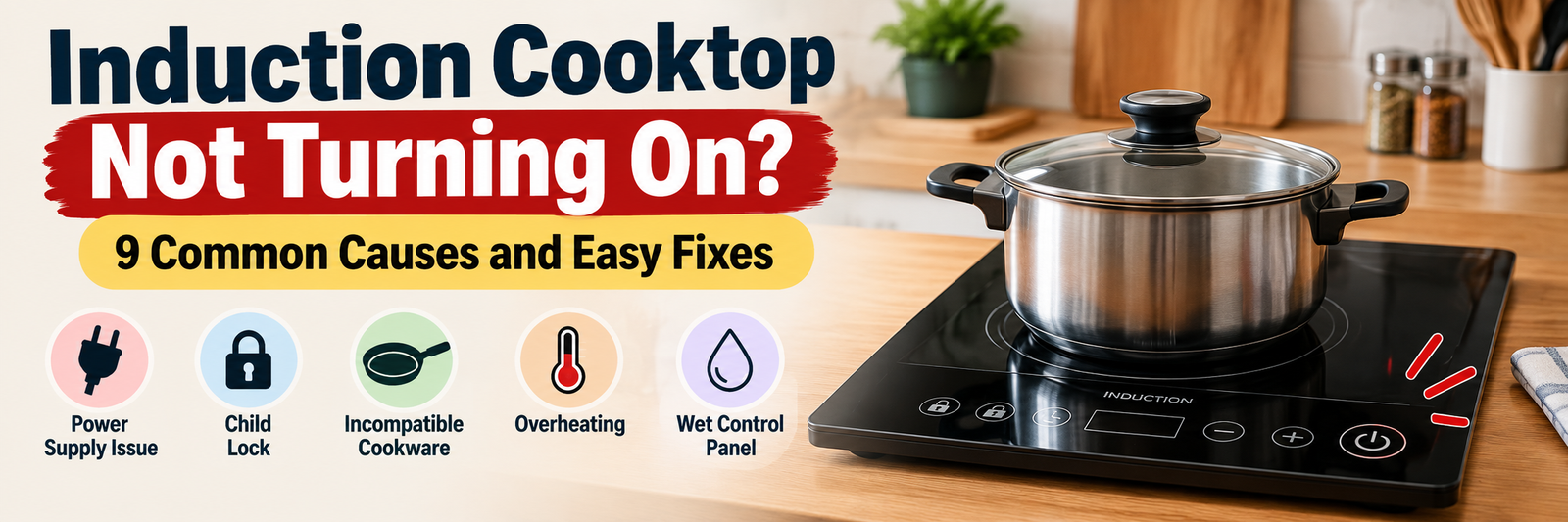
Induction Cooktop Not Turning On? 9 Common Causes and Easy Fixes
Is your induction cooktop not turning on, displaying an error code, or suddenly stopping while cooking? This is a common problem that can interrupt your daily kitchen routine. An induction cooktop may stop working because of power supply issues, incompatible cookware, overheating, an activated child lock, or internal electrical faults. Fortunately, some problems can be identified through simple troubleshooting checks without professional assistance. In this guide, we'll explain 9 common reasons why an induction cooktop stops working, how to identify the problem, safe troubleshooting methods, and when professional repair may be necessary.
Why Is My Induction Cooktop Not Turning On?
Quick Answer: An induction cooktop may fail to turn on because of an interrupted power supply, a faulty electrical socket, an activated child lock, overheating, or an internal electrical problem. If the appliance turns on but does not heat, incompatible cookware or incorrect pan placement may be responsible. Start by checking the power supply, control panel, and cookware compatibility. Always follow your manufacturer's instructions and avoid opening the appliance yourself.
Induction Cooktop Troubleshooting: Quick Reference
Use this troubleshooting table to identify the possible cause of your induction cooktop problem.
| Problem | Possible Cause | What to Check |
|---|---|---|
| No display or power | Power supply problem | Plug, socket, and circuit breaker |
| Display works but no heating | Incompatible cookware | Pan material and placement |
| Buttons do not respond | Child lock or wet controls | Lock settings and control panel |
| Cooktop stops during cooking | Overheating or automatic shut-off | Ventilation and timer settings |
| Error code appears | Model-specific fault | Manufacturer's error-code guide |
| Cooktop switches off repeatedly | Voltage or overheating issue | Power supply and ventilation |
| Burning smell or sparks | Possible electrical fault | Disconnect and seek professional help |
1. Check the Power Supply
A power supply problem is one of the most common reasons an induction cooktop does not turn on. A loose plug, damaged power cable, faulty electrical socket, or tripped circuit breaker can interrupt the electricity supply.
How to Fix It
- Switch off and unplug your induction cooktop.
- Check the power cable and plug for visible damage.
- Verify that the electrical socket is working.
- Check whether the circuit breaker has tripped.
- Make sure the appliance is connected according to the manufacturer's electrical requirements.
Avoid using unsuitable extension boards or adapters with high-power kitchen appliances. If the plug or cable is damaged, stop using the cooktop and arrange professional repair.
2. Check Whether the Child Lock Is Activated
Many modern induction cooktops include a child-lock feature that prevents accidental operation. When this feature is activated, the display may work normally, but the control buttons may not respond. This can make it appear as though the induction cooktop has stopped working.
How to Fix It
Check whether a lock symbol appears on the control panel. Refer to your model's instruction manual to find the correct unlocking procedure. Different brands use different button combinations, so avoid repeatedly pressing random controls. If the buttons remain unresponsive after deactivating the child lock, continue with the next troubleshooting steps.
3. Use Compatible Induction Cookware
If your induction cooktop turns on but does not heat, incompatible cookware may be responsible. Unlike traditional gas stoves, induction cooktops require cookware with a suitable magnetic base. Aluminium, copper, glass, and some stainless-steel utensils may not work unless they have an induction-compatible base.
How to Check Cookware Compatibility
Try these simple checks:
- Check whether your cookware is labelled induction-compatible.
- Place a magnet against the bottom of the pan.
- If the magnet sticks firmly, the cookware may be suitable for induction cooking.
- Confirm compatibility using the cookware manufacturer's instructions.
- Make sure the pan meets your induction cooktop's minimum size requirements.
Correct pan placement is also important. Some induction cooktops automatically stop heating when they cannot detect suitable cookware.
Should You Replace Your Induction Cooktop?
If your existing appliance repeatedly develops problems, compare its repair costs with the features and warranty coverage of newer models.
Our Best Induction Cooktop Under ₹3000 buying guide explains important features to consider before purchasing a budget-friendly induction cooktop for Indian cooking.
4. Check for Induction Cooktop Overheating
Induction cooktops use electronic components that generate heat during operation. Blocked ventilation, prolonged cooking, or high surrounding temperatures can contribute to overheating. Some models include automatic thermal protection that reduces power or switches off the appliance when excessive temperatures are detected.
How to Fix It
Follow these precautions:
- Switch off and unplug the induction cooktop.
- Allow the appliance to cool completely.
- Check whether its ventilation openings are blocked.
- Make sure the appliance has the recommended clearance around it.
- Follow the manufacturer's operating instructions.
Avoid placing the cooktop on surfaces that block its ventilation openings. If overheating happens repeatedly during normal cooking, contact an authorized service center.
5. Clean and Dry the Control Panel
Water, spilled food, or grease on a touch-sensitive control panel may interfere with its operation. Some induction cooktops temporarily disable their controls when moisture is detected. As a result, the buttons may stop responding even though the display is working.
How to Fix It
- Switch off and disconnect the appliance from the power supply.
- Allow the cooking surface to cool before cleaning.
- Use the cleaning method recommended by the manufacturer.
- Make sure the control panel is completely dry before attempting to operate the appliance again.
- Never spray water directly onto the electrical controls.
6. Check the Cooking Timer and Automatic Shut-Off
Some induction cooktops include cooking timers, automatic shut-off functions, and cookware detection features. These functions can stop the heating process automatically. For example, your cooktop may switch off when the cooking timer expires or when suitable cookware is removed.
How to Fix It
- Check whether a timer or automatic shut-off function is activated.
- Review your model's operating instructions to understand how these features work.
- Make sure compatible cookware is correctly positioned on the cooking surface.
- If the appliance continues switching off unexpectedly, investigate possible overheating or power supply problems.
7. Check the Induction Cooktop Error Code
Does your induction cooktop display an error code instead of heating? Different induction cooktop manufacturers use different error-code systems. An error code may indicate incompatible cookware, overheating, voltage problems, or an internal component fault. However, the meaning of an error code varies between brands and models.
How to Fix It
Follow these steps:
- Record the exact error code displayed.
- Check your induction cooktop's instruction manual.
- Find the manufacturer's explanation of the error.
- Follow the recommended troubleshooting instructions.
- Contact customer support if the problem continues.
Do not assume that the same error code has an identical meaning across different induction cooktop brands. If the appliance displays repeated error codes during normal operation, professional inspection may be necessary.
8. Check for Voltage Problems
An unstable or unsuitable electrical supply can affect induction cooktop performance. Some models display voltage-related errors or automatically stop operating when the electrical supply falls outside their supported range.
How to Fix It
- Check the electrical requirements listed in your induction cooktop's instruction manual.
- If your appliance displays a voltage-related error, follow the manufacturer's recommended troubleshooting procedure.
- Avoid repeatedly restarting the appliance during unstable electrical conditions.
- If you suspect a problem with your household wiring or electrical socket, consult a qualified electrician.
- Never attempt to modify the appliance's internal electrical components yourself.
9. Internal Circuit or Component Failure
If your induction cooktop is receiving power but still does not operate after basic troubleshooting, an internal component may have failed. Possible problems include a damaged control board, faulty internal wiring, or other electrical component failures. These problems cannot be diagnosed reliably through basic external checks.
How to Fix It
- Contact an authorized service center or qualified appliance technician.
- Do not open the induction cooktop housing or attempt internal electrical repairs yourself.
- If your appliance is still under warranty, contact the manufacturer before arranging third-party repairs.
Important: Immediately stop using your induction cooktop if you notice smoke, sparks, unusual noises, or a burning smell.
Why Is My Induction Cooktop Turning On but Not Heating?
An induction cooktop that turns on but does not heat may have a different problem from one that has no power at all. Possible causes include:
- Incompatible cookware
- Incorrect pan placement
- An activated safety feature
- Overheating protection
- A model-specific error
- An internal component fault
Start by checking whether your cookware is compatible with induction cooking. Make sure the pan is positioned correctly and meets the appliance's minimum size requirements. If the problem continues with suitable cookware, follow the manufacturer's troubleshooting instructions.
How to Prevent Induction Cooktop Problems
Regular cleaning and correct operation can help reduce avoidable induction cooktop problems. Follow these maintenance tips:
- Use cookware designed for induction cooking.
- Keep the control panel clean and dry.
- Avoid blocking ventilation openings.
- Follow the manufacturer's operating instructions.
- Use an appropriate electrical connection.
- Avoid placing excessively heavy cookware on the glass surface.
- Stop using the appliance if you notice electrical damage.
- Arrange professional inspection when problems repeatedly occur.
Proper maintenance can help your induction cooktop operate reliably.
When Should You Repair or Replace an Induction Cooktop?
Not every induction cooktop problem requires purchasing a new appliance. Problems involving incorrect cookware, child-lock settings, or blocked ventilation may be resolved without replacing the cooktop. However, repeated electrical faults or major internal component failures may require professional repair. Before deciding whether to repair or replace your appliance, consider its age, warranty coverage, estimated repair cost, and available replacement options.
If you're planning to buy a new appliance, read our induction cooktop buying guide for Indian kitchens. It explains useful buying considerations for budget-conscious households.
Frequently Asked Questions
1. Why is my induction cooktop not turning on even though the socket works?
Possible causes include an activated child lock, damaged power cable, or internal electrical fault. Check your model's instruction manual and contact an authorized technician if basic troubleshooting does not resolve the issue.
2. Why is my induction cooktop turning on but not heating?
Incompatible cookware, incorrect pan placement, overheating protection, or an internal component problem may prevent heating.
3. Can an induction cooktop stop working because of overheating?
Yes. Some induction cooktops include thermal protection that automatically reduces power or switches off the appliance when excessive temperatures are detected.
4. Why does my induction cooktop display an error code?
An error code may indicate a cookware detection problem, overheating, voltage issue, or internal fault. Always check the error-code guide for your exact model.
5. How do I know whether my cookware is induction-compatible?
Check the cookware's induction-compatible label or test its base with a magnet. A firmly attached magnet is a useful initial indicator, but you should also confirm compatibility with the manufacturer's instructions.
6. Why does my induction cooktop automatically switch off?
Possible causes include an expired cooking timer, cookware detection, overheating protection, or an electrical supply problem.
7. Can I repair an induction cooktop at home?
You can perform basic external checks and manufacturer-approved cleaning. Internal electrical repairs should always be handled by a qualified technician.
Final Thoughts
An induction cooktop not turning on does not always mean that the appliance needs replacing. Power supply problems, activated safety features, incompatible cookware, overheating, and incorrect operating settings are worth checking first. Begin with simple external troubleshooting and follow your manufacturer's instructions. If your induction cooktop repeatedly fails, displays persistent errors, or shows signs of electrical damage, arrange professional inspection. Regular cleaning, compatible cookware, and proper operating habits can help maintain your induction cooktop's performance.